Search for the best boats for families and most of what comes back reads the same way, no matter who wrote it. A sizing chart says a family of six needs a 20-foot boat, full stop, with no mention of whether that family boats on a calm lake or somewhere the wind can turn a calm morning into a choppy afternoon. A list of ten named models is genuinely useful if you already know you want a center console, but it does nothing for a family still deciding between a pontoon, a deck boat, and a console layout in the first place. A lot of it treats every body of water as interchangeable, which it is not, and that gap is where most families actually get stuck.
This list ranks seven boat types that consistently work well for families, in order of how broadly they fit the most common situations we see, with the practical tradeoffs the bigger generic guides skip. The advice gets more specific toward the end, where local water conditions actually change the answer, but the core logic holds wherever you boat.
1. Modified Vee Center Console
A modified vee hull, usually sitting around 14 degrees of deadrise at the transom, is the boat we point most families toward first. It splits the difference between stability and a comfortable ride better than almost anything else out there. At rest, it’s steady enough for kids to move around the deck or for someone to stand and cast. Under way, there’s still enough vee in the hull to cut through moderate chop instead of slapping across it the way a flatter hull does. For families dealing with calm mornings and breezier afternoons, that’s usually the safest place to start.
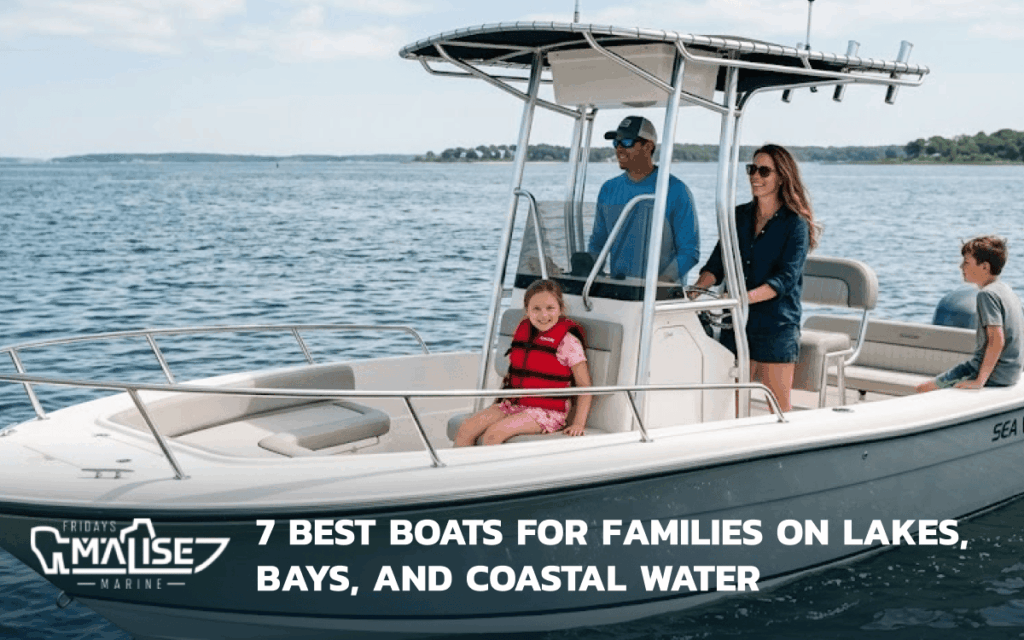
The layout advantage matters just as much as the hull shape. A center console gives a family 360 degrees of usable deck space instead of confining everyone to one cockpit area, which sounds like a fishing feature until you have several kids who all want to move around at once without climbing over each other. Several Sportsman Heritage models are built around exactly this kind of family-first layout, with cushioned bow seating and a finished helm area added on top of the open deck that makes the hull worth choosing in the first place.
2. Deep Vee Center Console
If your family’s boating regularly includes runs into more open, exposed water, a true deep vee hull earns its place on this list. A deadrise closer to 20 to 22 degrees lets the hull slice through waves instead of pounding across them, which is the entire reason this hull shape exists. The tradeoff is a bit more roll at a dead stop compared to a flatter boat, something most manufacturers offset with wider chines built into the hull near the waterline.
This is not the right first boat for a family that mostly anchors at a calm sandbar, since the extra capability comes with more weight and a higher price point for the same length. But for families who are already comfortable on the water and want the option to push farther when conditions allow, several Pair Custom Deep Vee models are built specifically with that kind of open-water running in mind, and the difference shows up the first time weather rolls in faster than the forecast suggested.
3. Dual Consoles
A dual console splits the difference between a center console and a bowrider, with a walk-through windshield connecting a forward seating area to the cockpit rather than leaving the bow fully open. Families who have one serious angler and several people who would rather relax than bait a hook tend to land here, since the dual console keeps a real fishing-capable cockpit while adding the kind of cushioned forward seating a center console usually skips.
The honest tradeoff is usable deck space. A dual console’s enclosed bow seating eats into the open walking room that makes a true center console so easy to move around on with a full crew of kids. For a family where fishing is occasional rather than the main reason for owning the boat, that tradeoff is usually a fair one, and a dual console typically rides on the same modified Vee or deep Vee hull options already covered above, so the same handling logic applies depending on which hull a specific model uses.
4. Shallow Draft Bay Boats
A dedicated bay boat trades some open-water capability for the ability to get into water most boats cannot reach, which matters for families who fish smaller creeks, marsh edges, and shallow tributaries where some of the best inshore fishing happens. These hulls run flatter forward and shallower overall than a true offshore console, often paired with a jack plate that lets the operator raise the motor to run in skinnier water without dragging the prop.
What families get in exchange for that shallow-water access is reduced rough-water comfort compared to a deeper hull, so a bay boat suits a family that stays mostly in protected creeks and the upper reaches of tidal rivers better than one planning regular runs into open, exposed water. Several Sportsman Masters models are built around this exact use case, with the fishing-specific features layered on top of a hull still comfortable enough for a full family day rather than a stripped-down tournament rig.
5. Pontoons
A pontoon earns a spot on this list with a clear condition attached. On calm, protected water, the stability and flat, open deck of a pontoon are genuinely hard to beat for a family that wants to lounge, swim, and spread out without worrying about anyone losing their footing. The catch is entirely about water type rather than the boat itself. The same flat-bottom design that makes a pontoon so stable at rest is the reason it can ride rough and feel genuinely unsettling the moment real chop builds.
Most experienced boating families end up treating a pontoon as a second boat rather than a primary one, kept for the calm days while a deeper hull handles anything rougher. If your family’s boating happens almost entirely on a single protected body of water, a pontoon is a completely reasonable first choice. If your plans ever include running toward more open water regularly, it is worth being honest about that limitation before buying.
Schedule Your Boat Detailing Today
Don't let the sun and sea compromise your boat's condition. Transform it with our expert detailing service.
CONTACT US6. Cabin Cruisers
A cabin cruiser is the right answer for a narrower set of families than the other boats on this list, specifically those planning actual overnight trips rather than day outings. The enclosed cabin with sleeping space, a small galley, and an enclosed head turns the boat into a genuine place to stay rather than just a way to get on the water, which matters for a family that wants to anchor overnight or cruise for a long weekend rather than returning to the dock every evening.
The cost of that capability is real. A cabin cruiser typically runs heavier and pricier than a similarly sized open boat, and the enclosed cabin space comes directly out of the open deck room that makes the other boats on this list so easy for a family to spread out on during a normal day trip. For most families whose boating is day trips rather than overnight cruising, the tradeoff does not make sense, but for the smaller group planning real multi-day trips, nothing else on this list replaces what a cabin cruiser offers.
7. Entry-Level Center Consoles
Not every family needs to start at the top of the size and power range, and an entry-level single-engine center console in the 21 to 23 foot range is consistently the boat we see first-time family buyers settle into successfully. Single-engine running costs stay manageable, the boat trailers easily behind a standard truck or SUV, and the size still covers the kind of fishing and cruising most families actually do on a normal weekend without requiring a slip or a larger tow vehicle.
The mistake we see most often with first-time buyers is undersizing for where the family will actually be in two or three years, rather than where they are today, since kids get bigger and gear accumulates faster than anyone expects. Several Sportsman Open models in the smaller end of that lineup cover this entry point well, carrying the same build standard and full warranty as the larger boats in the range, just at a size and price point that makes sense as a genuine first family boat.
The Best Boats for Families at a Glance
Reading through seven options in detail is useful once, but a side-by-side comparison makes it easier to go back and check your thinking later. Here is how the seven stack up on the things that matter most when a boat actually has a family on board.
| BOAT TYPE | BEST WATER | BEST FOR | MAIN TRADE-OFF |
| Modified Vee Console | Mixed calm and choppy | Most all-around families | Not built for serious open water |
| Deep Vee Console | Open or exposed water | Families who run farther out | Heavier, pricier, rolls more at rest |
| Dual Console | Mixed calm and choppy | Light fishing plus lounging | Less open deck room |
| Shallow Draft Bay Boat | Protected creeks, shallow flats | Families who fish backwaters | Rougher ride in open water |
| Pontoon or Tritoon | Calm, protected water only | Lounging, swimming, big groups | Struggles badly in real chop |
| Cabin Cruiser | Varies by hull design | Overnight and multi-day trips | Higher cost, less open deck |
| Entry-Level Console | Mixed calm and choppy | First-time family buyers | A smaller size limits the long-term room |
Features Every Family Boat Should Have
Features That Matter More Than Expected
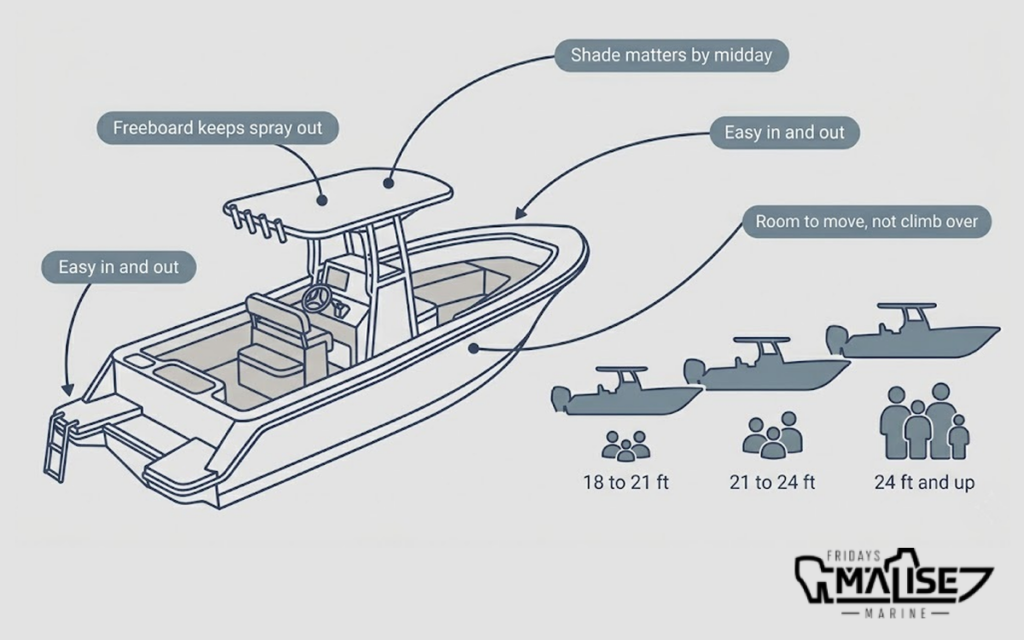
- 1. Freeboard, the height of the boat’s sides above the water, affects both safety and how dry everyone stays in rougher conditions
- 2. A bimini top or hard top stops being optional the first time a summer afternoon hits its peak heat with no shade on board
- 3. Step-free access from a swim platform back into the boat matters every time someone gets in and out for a swim, which on a good day might happen a dozen times before lunch
- 4. Enough flat, non-skid deck space for kids to move around rather than climb over each other
How New and Used Family Boats Compare
This decision matters more for families than for solo boaters. It comes down to how hard a boat actually gets used across a full season with kids aboard, not just the occasional calm weekend. A long structural hull warranty, with ten years being a meaningful benchmark, tells you something real about build quality. A builder backing a hull for a decade is making an actual financial bet that the construction holds up.
A used boat isn’t automatically the worst choice, but it asks more of the buyer. Service records matter more than the hour meter. A pre-purchase inspection that checks hull moisture and trailer condition is worth the cost every time, especially once life jackets, boat-specific car seats, and the rest of the family-boating gear get factored into the real number.
How Much Boat Does Your Family Really Need?
- 1. 3 to 4 people, casual day use, 18 to 21 feet is typically enough room without feeling cramped
- 2. 5 to 6 people, regular weekend use, 21 to 24 feet gives everyone real space for a cooler and gear
- 3. 6 or more, or frequent overnight trips, 24 feet and up, where storage and layout start mattering as much as raw capacity
Manufacturer capacity plates show the legal and safe maximum, not the comfortable number for a full day on the water. Most families are happier sizing up rather than down, since growing into a boat is a far better problem than outgrowing one within a season or two.
The Best Family Boat Depends on Where You Boat
Everything above holds no matter where you boat, but water conditions aren’t the same everywhere, and that’s the one variable most generic guides skip. A boat that feels perfect on a calm test ride at the dock can feel like a different boat three miles out, once wind and current start working against each other. Before you buy anything on this list, be honest about the roughest conditions your family is actually likely to hit, not the easy day you’re picturing.
We watch this play out constantly from our two shops on Virginia’s Middle Peninsula and Northern Neck, where families running the Chesapeake Bay deal with everything from calm, protected creeks to open water that turns choppy inside an afternoon. That range is exactly why water conditions keep coming up throughout this list. Start with where your family actually spends time and how far you realistically plan to run, then pick hull type and size around that instead of around a model name. The families who work through it in that order are the ones still happy with their boat two and three seasons later.
Frequently Asked Questions
What size boat is best for a family of 5?
Most families of five do comfortably on an 18 to 21-foot boat for casual day use, though many end up happier in the 21 to 24-foot range once gear, coolers, and the occasional extra guest get factored in. The honest answer depends heavily on whether trips are short runs near the ramp or full days on the water, since the second scenario benefits from more room than the minimum capacity rating suggests.
Is a pontoon or a center console better for a family?
It depends almost entirely on the water you boat on. A pontoon is excellent for calm, protected water where stability and lounging space matter most. A center console handles open or choppy water considerably better, and modern dual-purpose models close much of the comfort gap that used to make pontoons the default family answer.
Is a deep V hull better for families with kids?
A deep V or modified V hull generally rides drier and more comfortably in chop than a flat-bottom boat, which matters directly for keeping kids comfortable and reducing the chance of someone getting knocked around on a rougher day. The tradeoff is slightly less stability at a dead stop compared to a flatter hull, though most modern hulls offset this with wider chines.
How many people can safely fit on a family boat?
Every boat carries a manufacturer capacity plate showing the maximum safe number of people and total weight, and that number is a legal and safety limit, not a comfort recommendation. For an enjoyable full day on the water rather than a short ride, most families are more comfortable well under that maximum rating.